Fixed TNUoS Charges: What You Need to Know
Each year, NESO publishes several TNUoS forecasts ahead of the final tariffs that take effect from 1 April. The earliest indication is usually the ‘Five-Year View’, typically released in April, although this year it wasn't published until earlier this month. While useful for budgeting, these long-term forecasts can change significantly over time. Later forecasts released throughout the year tend to be more reliable, with final tariffs confirmed on 31 January for implementation from 1 April.
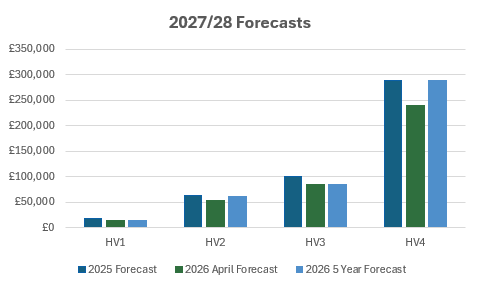
A good example is the 2027/28 forecast itself. The figures published in the initial April 2026 forecast differ noticeably from those contained in the latest forecast released last week, particularly for HV4 customers (11kV supplies at 2,001 kVA or over). In fact, the latest 2027/28 forecast for HV4 customers is around 20% higher than the equivalent forecast published in April. The chart below illustrates, for HV customers, the change to the 2027/28 forecast from the published forecast in 2025, and the forecasts released this year to date.
It can be tempting to look at the percentage changes from forecast to actual and apply them to future years for an indication of where the rates may land, however this is unlikely to be reliable as the tariffs move significantly as assumptions around transmission revenues, network investment and customer numbers are updated throughout the year. As an example, the increases introduced from April 2026 were among the largest many businesses had experienced, reflecting the significant investment required in Great Britain's transmission network, but while the final increases were still substantial, the final outcome for 2026/27 was on average 17% lower for HV and EHV customers than earlier forecasts had suggested.
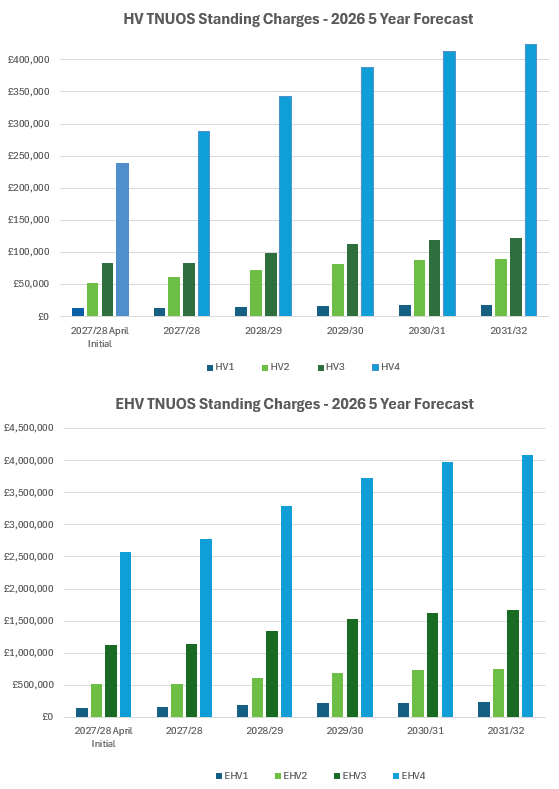
The charts below reflect the current 5-year forecast released earlier this month.
Charging Bands
There are currently no planned changes to the TNUoS charging band structure ahead of 31 March 2031. Customers should also be aware that charging bands are not automatically reviewed if electricity consumption falls.
For most HH metered sites, charging bands are linked to Available Supply Capacity (ASC). This means that simply using less electricity will not automatically move a site into a lower charging band. To potentially benefit from a lower band, a customer would typically need to reduce their ASC by more than 50% and formally request a review. For businesses that have significantly reduced their operational requirements, it may therefore be worth checking whether their current capacity remains appropriate.
If you’d like to run through your potential costs, please get in touch.